🔍 Why Do We Need OpenTelemetry Tracing?
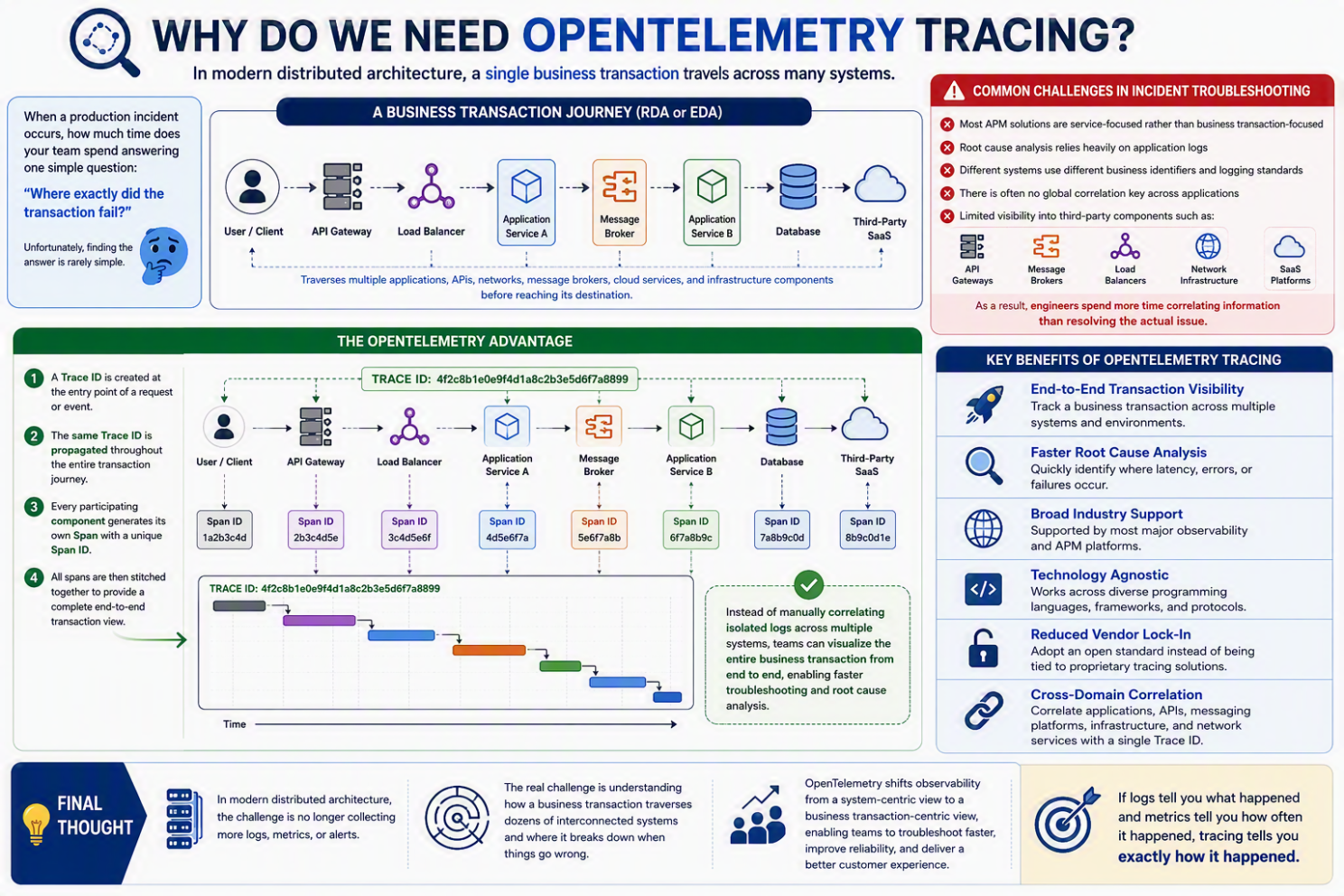
Whether your organization adopts a Request-Driven Architecture (RDA) or an Event-Driven Architecture (EDA), a single business transaction often traverses multiple applications, APIs, networks, message brokers, cloud services, and infrastructure components before reaching its destination.
When a production incident occurs, how much time does your team spend answering a seemingly simple question:
"Where exactly did the transaction fail?"
Unfortunately, finding the answer is rarely simple.
😖 Common Challenges in Incident Troubleshooting
Traditional monitoring and troubleshooting approaches often struggle because:
🔸 Most APM solutions are service-focused rather than business transaction-focused
🔸 Root cause analysis relies heavily on application logs
🔸 Different systems use different business identifiers and logging standards
🔸 There is often no global correlation key across applications
🔸 Limited visibility into third-party components such as:
API Gateways Message Brokers Load Balancers Network Infrastructure SaaS Platforms
As a result, engineers spend more time correlating information than resolving the actual issue.
🌐 The OpenTelemetry Advantage
OpenTelemetry has become the de facto open standard for observability and is supported by a broad ecosystem of vendors and technologies.
Here's how it works:
🟢 A Trace ID is created at the entry point of a request or event.
🟢 The same Trace ID is propagated throughout the entire transaction journey.
🟢 Every participating component generates its own Span with a unique Span ID.
🟢 All spans are then stitched together to provide a complete end-to-end transaction view.
Instead of manually correlating isolated logs across multiple systems, teams can visualize the entire business transaction from end to end, enabling faster troubleshooting and root cause analysis.
✅ Key Benefits of OpenTelemetry Tracing
End-to-End Transaction Visibility - Track a business transaction across multiple systems and environments. Faster Root Cause Analysis - Quickly identify where latency, errors, or failures occur. Broad Industry Support - Supported by most major observability and APM platforms. Technology Agnostic - Works across diverse programming languages, frameworks, and protocols. Reduced Vendor Lock-In - Adopt an open standard instead of being tied to proprietary tracing solutions. Cross-Domain Correlation - Correlate applications, APIs, messaging platforms, infrastructure, and network services with a single Trace ID.
💡 Final Thought
In modern distributed architecture, the challenge is no longer collecting more logs, metrics, or alerts.
The real challenge is understanding how a business transaction traverses dozens of interconnected systems and where it breaks down when things go wrong.
OpenTelemetry shifts observability from a system-centric view to a business transaction-centric view, enabling teams to troubleshoot faster, improve reliability, and deliver a better customer experience.
If logs tell you what happened and metrics tell you how often it happened, tracing tells you exactly how it happened.
🔔 Looking for more content like this? I share exclusive insights and tech summaries weekly on my LinkedIn Newsletter. Subscribe here to join the conversation!